

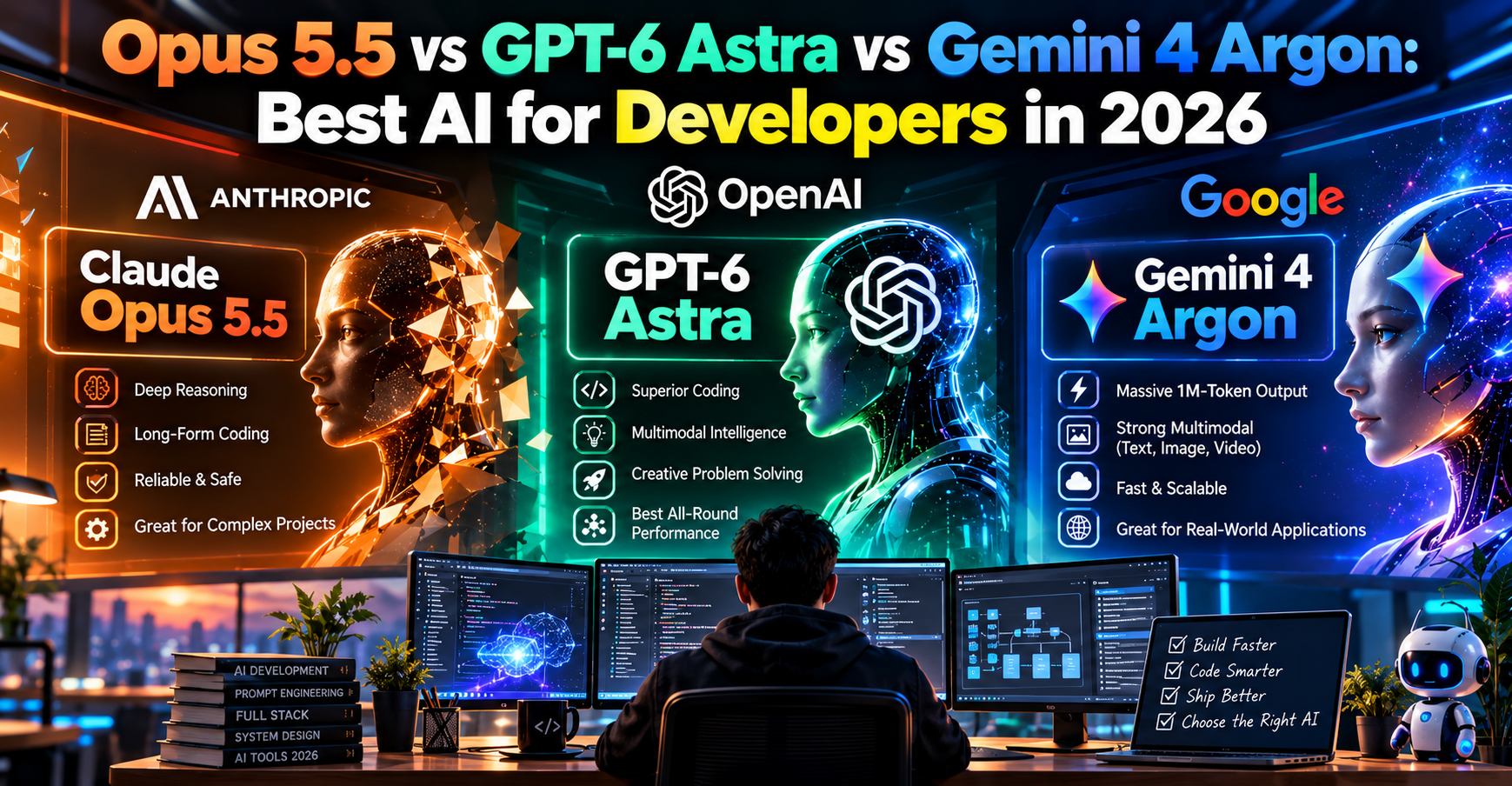
Three flagship models now compete for American developers’ attention: Anthropic’s Claude Opus 5.5, OpenAI’s GPT-6 Astra and Google’s Gemini 4 Argon. All three launched within weeks of each other this fall, and each claims the top spot somewhere.
Here is how they compare on price, benchmarks and practical fit, with a pick for each kind of work.
The Quick Answer
- Best overall quality: Claude Opus 5.5
- Best for science-heavy and complex reasoning work: GPT-6 Astra
- Best for very long inputs and outputs, and potentially the best value: Gemini 4 Argon, once it’s broadly available
- Best budget alternative: GPT-6.1 Sol, which isn’t in this three-way fight but belongs in your testing
At a Glance
| Claude Opus 5.5 | GPT-6 Astra | Gemini 4 Argon | |
|---|---|---|---|
| Maker | Anthropic | OpenAI | Google DeepMind |
| Launch | Sep 22, 2026 | Sep 3, 2026 | Sep 30, 2026 |
| API price (input / output per 1M tokens) | $4 / $20 | $10 / $50 | $2 / $10 intro, then $4 / $20 |
| Independent intelligence score (Artificial Analysis) | 58 | 53 | 53 |
| Avg. cost per index task | $5.98 | $3.26 | $1.99 (intro), about $3.98 at standard |
| Max output | 128K | 128K | 1M (partly via an experimental feature) |
| Availability | Broadly available | Broadly available | Limited rollout, wider access promised |
Opus 5.5 leads on measured intelligence but costs the most per task. Astra is the priciest per token, though it uses fewer tokens per task. Argon is cheapest under introductory pricing, but you may not be able to use it yet.
Benchmarks: Who Wins What
These figures come from Google’s evaluation table for Argon, which compares against rivals’ published results. Vendor-run comparisons favor their own model, so treat them as indicators and not final proof.
| Benchmark | Argon | Astra | Opus 5.5 | What it tests |
|---|---|---|---|---|
| DeepSWE v1.1 | 77.9 | 74.1 | 74.2 | Fixing issues in real codebases |
| FrontierSWE v2 | 55.0 | 65.5 | 62.3 | Hard software engineering |
| Terminal-Bench 4.0 | 57.4 | 58.2 | 66.4 | Terminal-based agent work |
| Vibe Code Bench | 91.9 | 89.6 | 90.3 | Building apps |
| PostTrainBench | 45.3 | 44.3 | 49.3 | ML engineering |
| AutomationBench | 51.3 | 41.4 | 42.5 | Multi-step business workflows |
| Terminal-Bench Science | 57.6 | 68.1 | 63.3 | Scientific workflows |
| GraphWalks 256K–1M | 84.2 | 71.8 | 66.8 | Very long context reasoning |
Reading the table: No model wins everything. Argon takes DeepSWE, app-building, automation and long-context tests. Opus 5.5 wins terminal-based agent work and ML engineering. Astra leads in science and the toughest software-engineering test. Because Argon posts the best DeepSWE number but the worst FrontierSWE result, “best coding model” depends on which kind of coding you do.
Price and Real Cost
Per-token price tells only part of the story. What matters is cost per finished task.
- Argon is verbose. Artificial Analysis measured about 62,000 output tokens per task against roughly 27,000 for Astra. Its discount hides that: at standard pricing, its per-task cost would roughly double to about $3.98. No end date has been announced for the introductory rate.
- Astra has the highest rate card ($10/$50) but its efficiency brings the per-task average to $3.26.
- Opus 5.5 costs the most per task ($5.98) in that test, but it also scores five points higher on the index.
GPT-6.1 Sol deserves a mention. It scores 52 on the same index at just $0.72 per task and $2/$10 per million tokens, so many teams may find a cheaper model is good enough for routine work.
Strengths and Weaknesses
Claude Opus 5.5
Strengths
- Highest independent intelligence score of the three (58)
- Leads on terminal-based agent tasks and ML engineering
- Available now, with broad cloud availability
Weaknesses
- Highest cost per task in Artificial Analysis testing
- Standard output ceiling of 128K, well below Argon’s
GPT-6 Astra
Strengths
- Top results in scientific and hard software-engineering benchmarks
- More efficient with tokens than Argon
- Strong in OpenAI’s Codex and ChatGPT ecosystem
Weaknesses
- Priciest per token ($10/$50)
- Weaker resistance to hidden-instruction attacks in one agent-safety test (8.5% success rate for attackers, versus 1% for Opus 5.5 and 0.7% for Argon)
- Higher hallucination rate in one test (51% versus 15% for Argon, though Argon answered fewer questions correctly overall)
Gemini 4 Argon
Strengths
- Best long-context reasoning and a 1M-token output ceiling
- Leads on app-building, business-workflow and DeepSWE benchmarks
- Very competitive introductory pricing
- Lowest hidden-instruction attack rate in testing (0.7%)
Weaknesses
- Limited rollout at announcement, with no stated date for general access
- Verbose outputs raise real costs
- Mixed results on terminal and some hard engineering tests
- Reports of internal Google doubts that real-world coding matches benchmark scores, which Google disputes
Which Should You Pick?
| If you need... | Best choice |
|---|---|
| Highest overall quality for complex agent work | Claude Opus 5.5 |
| Terminal-heavy agent workflows | Claude Opus 5.5 |
| Research and science-heavy reasoning | GPT-6 Astra |
| Codex and the OpenAI ecosystem | GPT-6 Astra (with Sol 6.1 for cheaper subtasks) |
| Analyzing huge codebases or documents | Gemini 4 Argon |
| Generating very long outputs | Gemini 4 Argon, with checks between steps |
| Office-style automation | Gemini 4 Argon (based on current benchmarks) |
| Lowest cost for routine work | GPT-6.1 Sol |
| Something you can use today | Opus 5.5 or Astra |
A common approach among teams is to mix models: a top-tier model for planning and hard problems, plus a cheaper one for execution and testing.
How to Choose Without Guessing
- Build a small test set. Collect 10 to 15 real tasks from your own work, such as a bug you fixed, a refactor or a missing test, with known good answers.
- Measure cost per solved task, not cost per token.
- Keep your model name in configuration, not scattered in code, so swapping models takes one line.
- Use a router or gateway if you work with several vendors.
- Retest when pricing changes, especially when Argon’s introductory rate ends.
Open Questions
- When will Argon be broadly available, and what will it cost then?
- How will each model perform on messy, real-world repositories compared with benchmarks?
- Will speed differ in practice? Argon’s speed hasn’t been independently measured.
- Will prices keep falling? Several labs cut API prices this fall.
There is no single winner. Opus 5.5 offers the highest measured quality and is ready today. Astra is the pick for science and the toughest engineering problems. Argon looks strongest on long context and value, but you may have to wait to use it, and its verbosity can eat into the savings. For most American developers, the smartest move is to test two models on your own tasks and route work accordingly.