

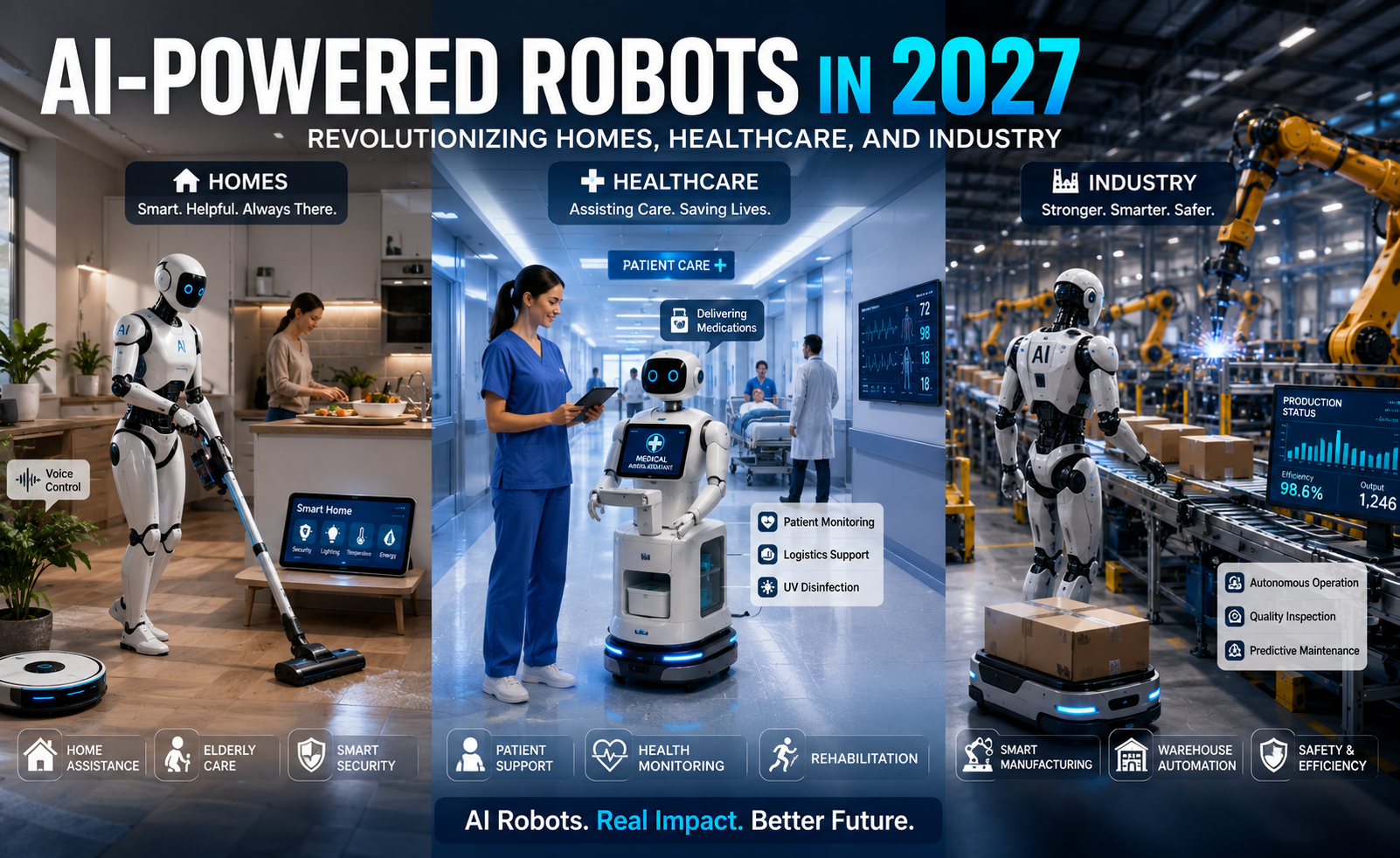
AI-Powered Robots in 2027: Revolutionizing Homes, Healthcare, and Industry
Artificial intelligence is transforming robots from simple machines into intelligent assistants capable of learning, adapting, and working alongside people. By 2027, AI-powered robots are expected to play a much bigger role across the United States and the United Kingdom, helping businesses improve productivity, supporting healthcare professionals, and making everyday life easier at home.
From hospitals and warehouses to smart homes and manufacturing plants, robots are becoming an essential part of the future economy. While they won't replace people entirely, they will increasingly take on repetitive, dangerous, and time-consuming tasks, allowing humans to focus on work that requires creativity, critical thinking, and personal interaction.
Let's explore how AI-powered robots are expected to reshape homes, healthcare, and industry by 2027.
AI Robots Are Becoming Smarter Than Ever
Unlike traditional industrial robots programmed for a single task, modern AI-powered robots can:
Understand voice commands
Recognize people and objects
Learn from previous experiences
Navigate unfamiliar environments
Work safely alongside humans
Make real-time decisions using AI
This new generation of intelligent machines is making robotics more practical for businesses and households across the US and UK.
AI-Powered Robots in Healthcare
Healthcare is expected to become one of the fastest-growing sectors for AI robotics.
Hospitals are increasingly exploring robotic solutions that help doctors, nurses, and caregivers provide better patient care while reducing administrative workloads.
Hospital Support Robots
AI-powered robots can assist with:
Delivering medicines
Transporting medical equipment
Moving laboratory samples
Delivering meals
Managing hospital inventory
Supporting patient check-ins
These tasks allow healthcare professionals to spend more time caring for patients.
AI-Assisted Surgery
Robotic-assisted surgical systems continue to improve precision during complex medical procedures.
Benefits may include:
Smaller surgical incisions
Greater precision
Reduced blood loss
Faster patient recovery
Improved surgical planning
These technologies are expected to become increasingly common in advanced hospitals across the United States and the United Kingdom.
Elderly Care Robots
As populations continue to age, AI-powered robots are expected to assist elderly people living independently.
Future home-care robots may help with:
Medication reminders
Fall detection
Emergency alerts
Health monitoring
Video communication with family
Daily activity assistance
Rather than replacing caregivers, these robots will support both families and healthcare professionals.
Smarter Homes With AI Robots
By 2027, home robots are expected to become more capable than today's robotic vacuum cleaners.
Future AI home assistants may perform tasks such as:
Cleaning multiple rooms
Monitoring home security
Managing smart appliances
Preparing simple meals
Assisting older adults
Organizing household schedules
Monitoring indoor air quality
Voice-controlled AI assistants will also become more conversational, understanding natural language and adapting to individual family routines.
AI Robots in Manufacturing
Manufacturing remains one of the biggest adopters of AI-powered robotics.
Factories across the US and UK are investing in robots that can:
Assemble products
Inspect quality
Package goods
Operate machinery
Handle heavy materials
Perform hazardous tasks
Unlike older robots, modern AI systems can adjust to changing production requirements with minimal reprogramming.
This flexibility helps manufacturers increase productivity while reducing operational costs.
Smarter Warehouses and Logistics
E-commerce growth continues to drive demand for warehouse automation.
AI-powered warehouse robots are expected to:
Pick products
Sort packages
Move inventory
Track stock levels
Optimize delivery routes
Assist warehouse employees
Faster order processing benefits both businesses and customers through improved delivery times.
AI Robots in Retail and Hospitality
Retail stores, hotels, airports, and restaurants are also adopting intelligent robotics.
Potential applications include:
Customer assistance
Self-service information kiosks
Food delivery
Inventory management
Room service
Cleaning and sanitation
Airport guidance
These robots help businesses improve efficiency while enhancing customer experiences.
Education and Research
Educational institutions are increasingly using AI-powered robots to improve learning experiences.
Robots may assist students by:
Teaching STEM subjects
Supporting language learning
Demonstrating scientific concepts
Providing personalized tutoring
Helping students with disabilities
Universities are also using robotics to accelerate research and innovation.
Benefits of AI-Powered Robots
The growth of intelligent robotics offers several advantages:
Increased workplace productivity
Improved healthcare services
Enhanced workplace safety
Better customer experiences
Reduced repetitive work
Higher operational efficiency
Faster data-driven decision making
Around-the-clock operation
These benefits are encouraging businesses throughout the US and UK to invest in AI-driven automation.
Challenges Ahead
Despite rapid progress, several challenges remain before AI robots become commonplace.
These include:
High initial investment costs
Integration with existing systems
Workforce training
Cybersecurity risks
Public acceptance
Technical maintenance
Ethical use of AI
As technology matures, many of these challenges are expected to become easier to manage.
Industries Leading AI Robot Adoption
By 2027, AI-powered robots are expected to expand across numerous sectors, including:
Healthcare
Manufacturing
Logistics
Retail
Hospitality
Agriculture
Construction
Education
Security
Smart Cities
These industries are likely to experience significant productivity improvements through AI automation.
What US and UK Readers Can Expect by 2027
People living in the United States and the United Kingdom are likely to see AI-powered robots become more common in everyday environments.
Expected developments include:
Smarter hospitals using AI assistants
Intelligent warehouse automation
More advanced home robots
AI-powered elderly care solutions
Robotic customer service in retail
Faster logistics and delivery systems
Greater use of AI in manufacturing
Expansion of smart city technologies
Although fully autonomous humanoid robots may still be in the early stages, intelligent service robots are expected to become increasingly visible in daily life.
Final Thoughts
AI-powered robots in 2027 represent one of the most exciting technological shifts of the decade. Across the United States and the United Kingdom, these intelligent machines are expected to improve healthcare, transform manufacturing, enhance logistics, and simplify everyday living.
Rather than replacing human workers, the next generation of AI robots will work alongside people—handling repetitive tasks, improving efficiency, and allowing professionals to focus on higher-value work.
As AI technology continues to evolve, businesses, healthcare providers, and individuals who embrace robotics will be better positioned to benefit from the next wave of innovation. The future of AI-powered robots is no longer a distant vision—it is becoming a practical reality.