

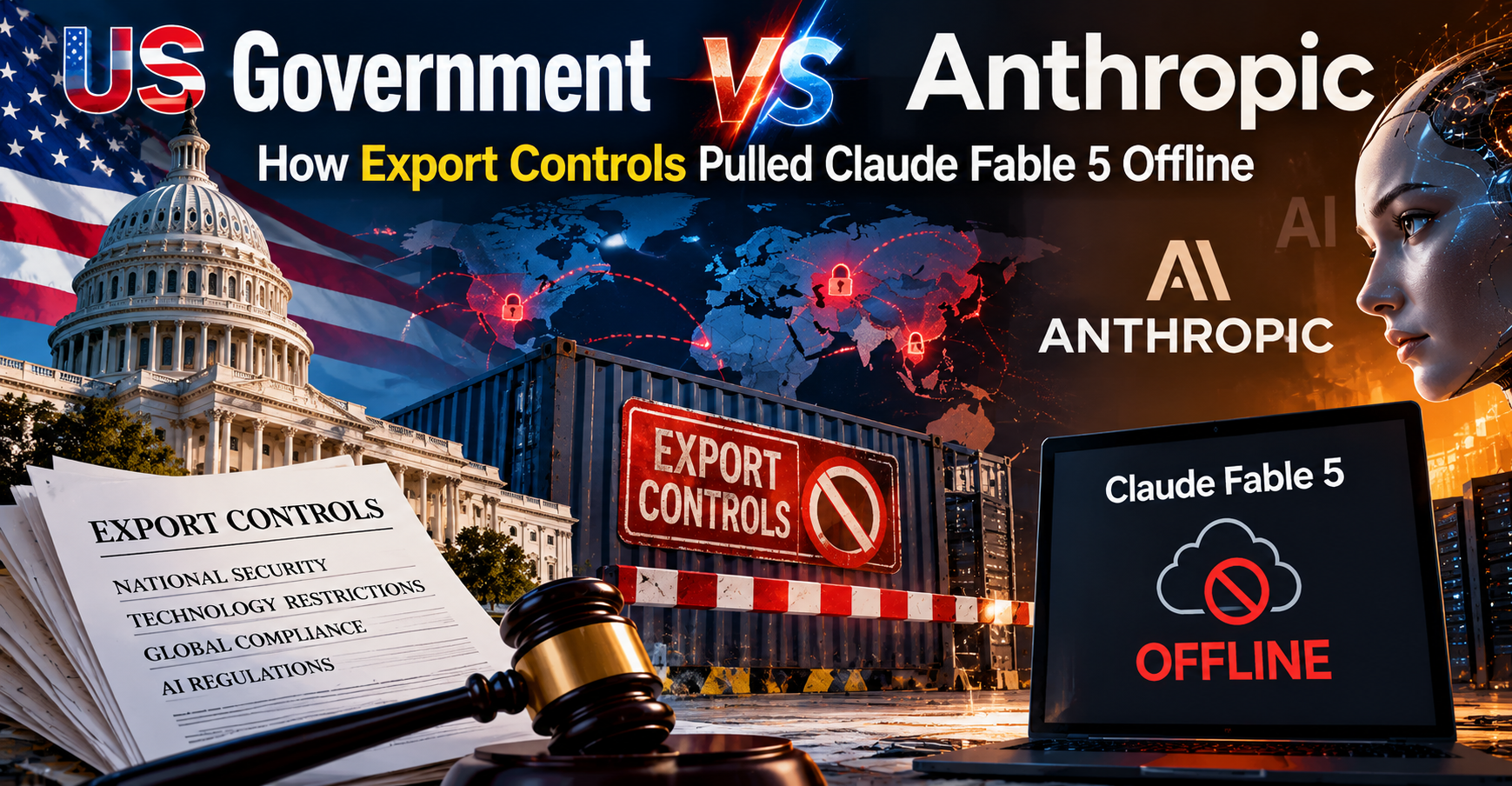
In June 2026, one of the most powerful AI models ever released to the public disappeared from the internet in three days. The cause was not a technical failure or a security breach inside Anthropic. It was a directive from the US Department of Commerce, the first time the government used export-control authority to take a named frontier AI model offline.
Here is what happened, why, and what it means for AI companies and their customers.
What Were Claude Fable 5 and Mythos 5?
Claude Fable 5 launched on June 9, 2026, as the first public model in Anthropic’s new “Mythos-class” tier, positioned above the company’s Opus line. It was built for long-running agent tasks and was available through Anthropic’s API and several cloud platforms.
Claude Mythos 5 is built on the same underlying model but with fewer safety restrictions. It was offered only to approved organizations through Project Glasswing, Anthropic’s program for vetted partners. A preview version, Mythos Preview, had already been in the hands of select government and technology partners since April.
The strongest capability of this class is cybersecurity: finding and fixing software vulnerabilities, which also makes it sensitive from a national-security standpoint.
Timeline: Nineteen Days Offline
| Date | Event |
|---|---|
| June 9 | Fable 5 launches publicly |
| June 12 | Commerce issues an export-control directive; Anthropic disables both models worldwide |
| June 26 | Commerce allows Mythos 5 to return for a limited group of vetted US companies and federal agencies |
| June 30 | Commerce lifts the controls; Anthropic announces it will restore access |
| July 1 | Fable 5 returns across Anthropic’s own products, including Claude.ai, Claude Code and the API |
The suspension came just three days after launch.
What the Directive Required
On June 12, the Commerce Department, citing national-security authorities, ordered Anthropic to block access to Fable 5 and Mythos 5 for any foreign national, anywhere in the world. That included people living and working inside the United States, and it covered Anthropic’s own foreign-national employees.
Anthropic said it could not reliably verify every user’s nationality in real time, so it shut the models off for all customers globally to ensure compliance.
Legal analysts noted an unusual feature: the government did not add the models to the Commerce Control List through the normal Federal Register rulemaking and classification process. Instead, it reached the company’s access controls directly, using an unpublished directive. That left open how far export controls can extend over a hosted AI service, including whether they cover model weights, specific outputs or API access.
What Triggered It
Reporting points to a security report by Amazon researchers, who said they had found a way to jailbreak Fable’s cybersecurity capabilities. The administration then imposed the controls.
Anthropic disputed how serious the issue was. In its June 12 statement, the company said the government had given it only verbal evidence of a potentially narrow, non-universal jailbreak, one that essentially involved asking the model to read a codebase and fix flaws. Anthropic argued that if the same standard were applied across the industry, it would halt all new model deployments.
The government’s position, as described in coverage, was that the model’s cyber capability and the reported bypass raised national-security concerns serious enough to justify restricting access while it was evaluated.
How It Ended
After about two weeks of negotiation with the White House and Commerce, the department granted a partial reopening on June 26, then lifted the controls entirely on June 30. Commerce Secretary Howard Lutnick said Anthropic and Commerce had worked closely to analyze and approve Fable 5.
Two things made the reversal possible:
- A new safety classifier. Anthropic added guardrails that it says block the reported bypass in more than 99% of tests. Commerce’s Center for AI Standards and Innovation (CAISI) tested it independently.
- Commitments to the government. According to Lutnick, Anthropic agreed to proactively detect and address security risks in the models, to work with the US government on protocols, standards and releases for Mythos, Fable and future models, and to inform the government of any malicious activity.
Commerce also reserved the right to re-evaluate and reimpose a license requirement if circumstances change or if Anthropic fails to meet its commitments.
Anthropic restored Fable 5 starting July 1, said it would bring it back to AWS, Google Cloud and Microsoft Foundry as soon as possible, and continued expanding Mythos 5 access through Glasswing. Paid subscribers received extended full access to Fable 5 through July 12 to make up for the outage.
Why It Matters
1. A new kind of regulation. Export controls had mostly applied to chips and physical technology. This episode showed they can be used against a hosted model’s availability, even without a public rule.
2. Continuity risk for customers. Businesses building on a single AI provider learned that a model can vanish overnight for reasons outside the provider’s control. Teams now have a stronger case for multi-vendor setups and fallbacks.
3. A possible template for every lab. Because the resolution involved ongoing cooperation covering “future models,” some analysts see a model for how frontier labs will work with Washington. Critics worry that access to the best US models could come to depend on bespoke arrangements with one agency, while supporters say close testing of high-risk capabilities is reasonable.
4. International fallout. Foreign customers and governments, including firms in South Korea tied to Project Glasswing, were cut off or left uncertain during the suspension.
5. Unresolved legal questions. The unpublished directive left open how export law applies to API inference, outputs and weights.
Two Sides of the Debate
Supporters of the government’s action argue that a model capable of finding serious software flaws warrants fast, cautious intervention, and that an independent government test of the fix was a sensible safeguard.
Critics, including Anthropic, argue that acting on a narrow, verbally described issue, without a published rule, was disproportionate and set an unpredictable precedent for the whole industry. They point out that the same type of reported bypass could be claimed against other labs’ models.
What Came Next
Anthropic returned to releasing models within weeks. On September 1 it launched Claude Fable 5.1 alongside a trusted-access twin, Mythos 5.1. The pattern of limited, vetted access for the most cyber-capable systems has since spread: OpenAI’s GPT-6 Astra and Google’s Gemini 4 Argon have also launched first to restricted groups of defenders and government users.
The Fable 5 suspension was brief, but it changed expectations. A frontier model can now be switched off by a government directive within days of launch, and getting it back may require ongoing commitments to regulators. For AI users, the lesson is practical: don’t depend on a single model. For policymakers and labs, it’s a reminder that rules for hosted AI are still being written, in real time.