

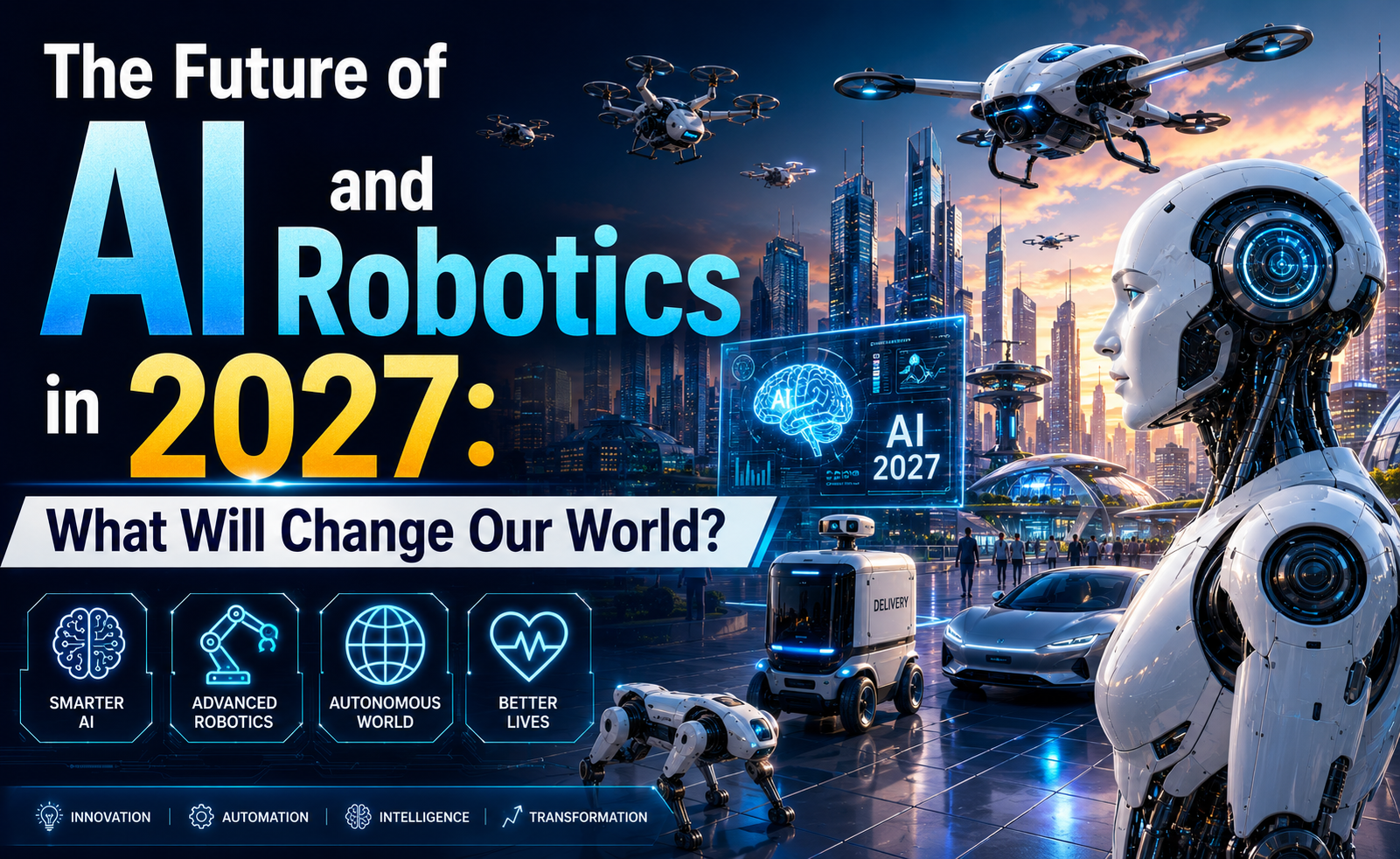
The Future of AI and Robotics in 2027: What Will Change Our World?
Artificial intelligence is no longer limited to chatbots and digital assistants. By 2027, AI is expected to become a bigger part of everyday life across the United States and the United Kingdom, powering smarter workplaces, healthcare, transportation, education, and even homes. At the same time, robotics is evolving from factory machines into intelligent assistants capable of working alongside people.
For millions of people in the US and UK, the question is no longer if AI and robotics will change life—but how quickly.
Let's explore the biggest AI and robotics trends expected to shape 2027.
1. Humanoid Robots Will Enter More Workplaces
One of the most exciting developments is the rise of humanoid robots. Unlike traditional factory robots that perform one repetitive task, humanoid robots are designed to move, interact, and work in environments built for people.
By 2027, businesses across the United States and the United Kingdom are expected to increase pilot programs involving humanoid robots in:
Warehouses
Manufacturing plants
Distribution centers
Hospitals
Hotels
Retail stores
Rather than replacing entire workforces, these robots are likely to assist employees by handling repetitive, physically demanding, or potentially hazardous tasks.
Why it matters
For businesses, this could improve productivity and reduce labor shortages. For workers, it means spending more time on skilled and customer-focused responsibilities.
2. AI Will Make Homes Smarter Than Ever
The smart home is becoming far more intelligent.
By 2027, AI-powered home systems are expected to:
Learn your daily routine
Reduce energy consumption
Improve home security
Manage appliances automatically
Assist elderly family members
Monitor health and wellness
Future AI assistants will understand natural conversations much better than today's virtual assistants, allowing homeowners to control nearly every connected device through simple voice commands.
For families across the US and UK, AI will increasingly become an invisible helper rather than a separate gadget.
3. Healthcare Will Experience a Major AI Revolution
Healthcare is expected to become one of the biggest beneficiaries of AI.
Hospitals and healthcare providers may increasingly use AI for:
Medical imaging analysis
Faster diagnosis support
Personalized treatment recommendations
Remote patient monitoring
Hospital workflow optimization
Robotic systems are also expected to assist surgeons with greater precision while allowing doctors to focus more on patient care.
Patients in both countries could benefit from faster diagnoses, shorter waiting times, and more personalized healthcare services.
4. Self-Driving Technology Will Continue to Improve
Autonomous driving technology continues to evolve.
Although fully autonomous vehicles may not yet dominate public roads everywhere by 2027, AI is expected to improve:
Driver assistance systems
Fleet management
Delivery robots
Last-mile logistics
Smart traffic management
Businesses across the US and UK are investing heavily in AI-powered transportation solutions to improve efficiency and reduce operational costs.
5. AI Will Transform the Workplace
AI is rapidly becoming a workplace assistant instead of just a software tool.
Employees will increasingly use AI for:
Writing reports
Data analysis
Coding
Customer support
Marketing content
Scheduling
Research
Business forecasting
Instead of replacing every job, AI is more likely to automate repetitive tasks while allowing professionals to focus on creativity, communication, and strategic decision-making.
Workers who develop AI skills will likely have stronger career opportunities in the coming years.
6. Education Will Become More Personalized
Schools, colleges, and online learning platforms are expected to embrace AI-powered education.
Future AI learning systems may:
Create personalized study plans
Adapt lessons based on student performance
Provide instant tutoring
Generate practice exams
Offer real-time language translation
Students across the US and UK could experience more customized learning than ever before.
7. Businesses Will Invest Heavily in AI Automation
Large organizations are expected to continue increasing investments in AI-powered automation.
Industries likely to see the biggest growth include:
Banking
Healthcare
Manufacturing
Retail
Logistics
Finance
Customer service
Cybersecurity
Businesses adopting AI successfully may improve productivity while delivering faster and more personalized customer experiences.
8. Robotics Will Expand Beyond Factories
Robots are expected to appear in more everyday environments.
Examples include:
Restaurant service robots
Hotel assistants
Airport customer service robots
Hospital delivery robots
Warehouse automation
Agricultural robots
Cleaning robots
Security patrol robots
Many of these systems are already being tested and are expected to become more common over the next few years.
9. AI Will Create New Career Opportunities
Every technological revolution creates new jobs.
The AI revolution is expected to increase demand for professionals in:
AI Engineering
Robotics Engineering
Machine Learning
Data Science
AI Security
Cloud Computing
Prompt Engineering
Robotics Maintenance
AI Product Management
For students and professionals in both the United States and the United Kingdom, learning AI-related skills could become one of the smartest career investments.
10. Human-AI Collaboration Will Become the New Normal
Perhaps the biggest change by 2027 won't be robots replacing humans—it will be humans and AI working together.
Future workplaces are likely to combine:
Human creativity
AI intelligence
Robotic precision
Real-time automation
Faster decision-making
Organizations that successfully blend human expertise with AI technology are expected to gain a significant competitive advantage.
What US and UK Readers Should Watch in 2027
If you live in the United States or the United Kingdom, keep an eye on these emerging trends:
More AI assistants in everyday devices
Smarter healthcare technologies
Expansion of warehouse and logistics robots
Growth of humanoid robot pilot programs
AI-powered customer service across businesses
Autonomous delivery solutions
Increased adoption of AI in education
AI-driven productivity tools for professionals
Growth in AI-related career opportunities
Wider use of robotics in public services
Final Thoughts
The future of AI and robotics in 2027 is not about science fiction—it is about practical innovation becoming part of everyday life. From smarter homes and hospitals to intelligent workplaces and advanced robotics, AI is expected to reshape how people live and work across the United States and the United Kingdom.
Businesses that embrace AI responsibly and individuals who develop AI skills will likely be better prepared for the next wave of technological change. While the future will continue to evolve, one thing is becoming increasingly clear: AI and robotics will be among the defining technologies of the decade.
Whether you're a business owner, student, technology enthusiast, or working professional, 2027 promises to be an exciting year for innovation.